Postman News Latest News, Live Breaking News, Today News …

Related Articles


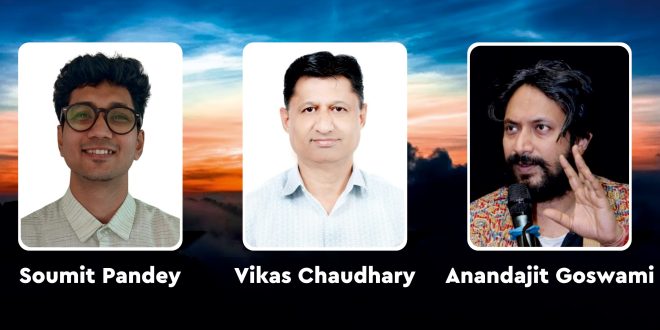
— Article is authored by Vikas Chaudhary , Anandajit Goswami , Soumit Pandey
The future of VIKSIT Bharat depends on the AI adoption of large and medium, small and micro (MSME) firms because these firms must adapt to the new technological evolution and, at the same time generate employment and export potential of India by 2047. In 2025, through various government schemes like PM Vishwakarma Scheme, SFURTI, employment potential of more than 2,20,000 people have been generated. Credit access enhancement for MSMEs is being increased through Credit Guarantee Fund Trust, and the new customised Credit Card scheme for micro enterprises. These are expected to boost job creation. For the Viksit Bharat 2047, it is an imperative that MSMEs increase their output and job creation potential through skill development, promotion of labour intensive industries and by making conducive environment for doing business for MSMEs.
It also has to be remembered that with the onset of AI and other new digital technological evolution, MSMEs have to gradually live up to the new realities of next-generation automated technologies. Further, the sustainability indicators of these MSME firms have to improve too given that India is taking a leadership role in the global climate action measures through mitigation and adaptation measures. To test this, it needs to be seen how the improvement of ESG (Environment, Social and Governance) indicators can further impact the nature and degree of AI adoption of MSMEs.
Through research conducted on Environment (E), Social (S), and Governance (G) performance indicators of 21460 large and MSME firms of the Faridabad district of Haryana, India on their artificial intelligence (AI) adoption, certain directions are arrived at for future policy conclusions and decision making. The empirical and quantitative research at the subnational level indicates the nature, type, rural/urban orientation, location, and social performance of the firms can significantly impact the extent of AI adoption of these firms. This opens out certain subnational realities for a smooth transition of these MSMEs towards the Viksit Bharat Goal of 2047 while maintaining their sustainability pathway paradigm.
It directs us towards the fact that schemes like SFURTI, which promote cluster development, sustainable employment, have to gradually reorient themselves towards the enhancement of the social performance of subnational MSMEs. To do that, policies have to be implemented to ensure equity funding to these MSMEs so that they can be self reliant in the social indicator adoption and can further grow with technology adoption with the advent of AI. Today or tomorrow, finally these MSMEs have to adopt AI for their own survival, and hence in the initial years, equity funding support for making them self-reliant towards such adoption will help.
While promoting equity funding into these MSMEs, what will be important is to understand how the MSMEs can be further strongly integrated into the Make in India campaign. The nature of the MSME sector also has to be kept in mind while doing this integration in order to ensure that sustainable employment generation is created from these sectors. Many of these MSMEs are often first-time entrepreneurs and would need sustained support from the Government of India to enhance their ESG performance and AI adoption. In our empirical analysis of the 22,000 firms, the strong relationship between the Social Performance of the firm and AI adoption has clearly emerged. Another support structure that needs to be created for the sustained growth and ESG performance of these MSMEs is the procurement of goods and services by central and state government departments from these MSMEs. Such demand-side support will ensure that MSMEs can enhance their ESG performance over the long term, which in essence will also make them more mature in their long-term adoption of AI. Wherever required, in this transition process of the MSMEs, the Prime Minister’s Employment Generation Programme (PMEGP) has to be tapped for project costs, making it more attractive for setting up new businesses and helping these MSMEs towards their long-term transition. However, currently, MSMEs have been facing the challenge of access to credit, technology, and infrastructure bottlenecks. Moreover, delayed payment addressal has to be immediately looked after through effective policy implementation. Once all this is done, India can move towards a successful AI adoption pathway of MSMEs through ESG performance improvement, which in a way in the long run will help in attaining the Viksit Bharat 2047.
Thus, to attain the VIKSIT Bharat goal, while balancing the technological adoption and evolution of MSMEs, sub-national policies must focus on transparency, regulation, and monitoring of the social, governance, and environmental performance of firms in the means of digital transformation of MSMEs for the future.
(Disclaimer: The views and opinions expressed in this article are those of the author only and do not necessarily reflect the views of PostmanNews.com)